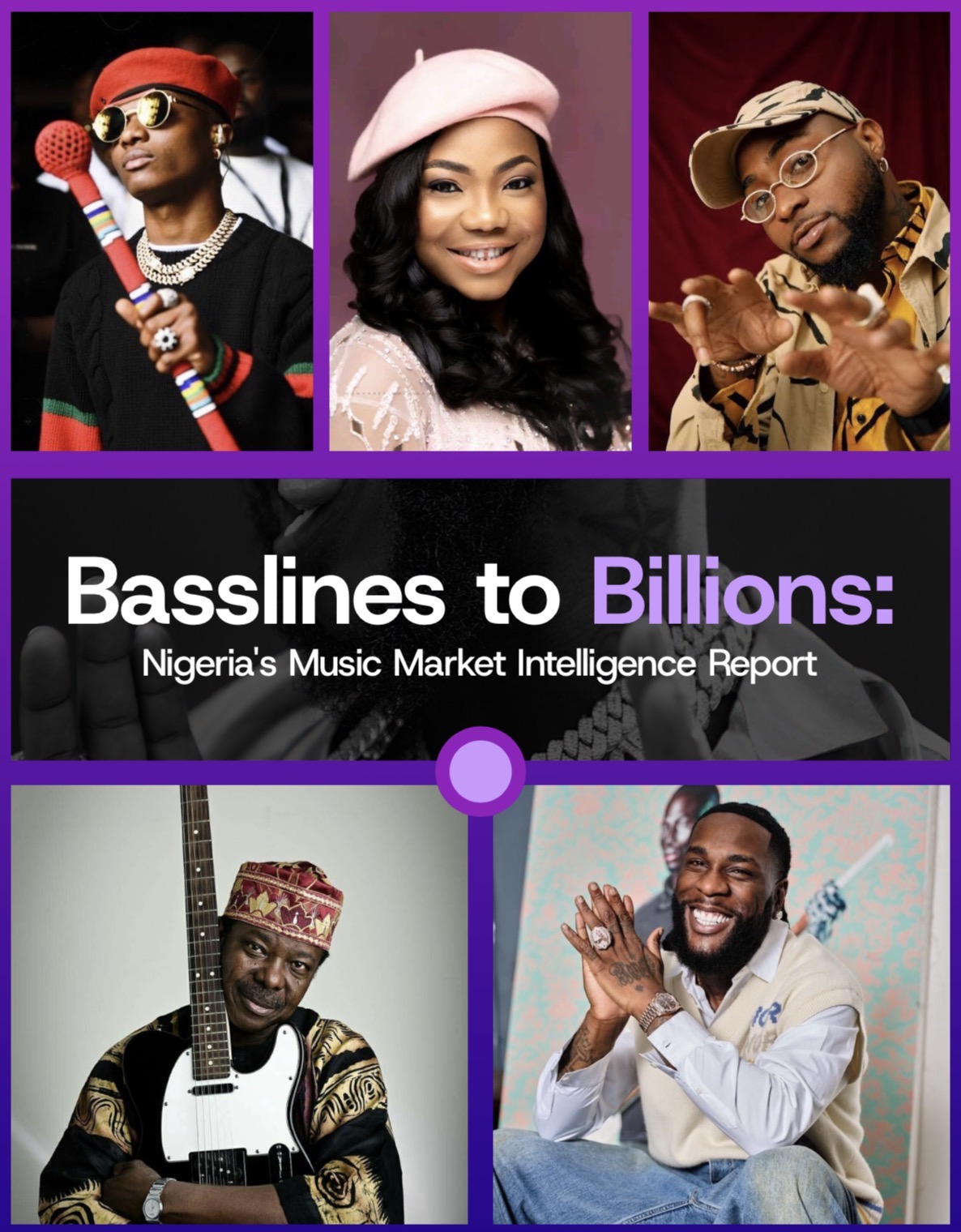
Nigeria’s music industry has reached a defining economic milestone, generating an estimated ₦901,664,585,962.50 (≈₦901.7 billion) in annual earnings, equivalent to $600,739,723.98, according to Basslines to Billions: Nigeria’s Music Market Intelligence Report. Produced by RegalStone Capital in collaboration with the National Council for Arts and Culture (NCAC), the report provides one of the most comprehensive recent attempts to quantify the structure, size, and earnings potential of Nigeria’s music economy using platform analytics, market intelligence, and financial modelling.
Far from being driven by recorded music alone, the Nigerian music economy is powered primarily by live performances. The report reveals that concerts, festivals, corporate bookings, faith-based events, and international touring accounted for 65.74 percent of total artist earnings in 2024, making live music the dominant revenue engine for creators. From Detty December festivals that attract thousands of inbound tourists to sold-out arena shows across Europe and North America, Nigerian artists continue to earn the bulk of their income on stage, where fees are paid directly and revenue leakage is significantly lower than in digital distribution.

Streaming and digital platforms, while rapidly expanding in reach and cultural influence, still lag behind live performances in revenue contribution. In 2024, streaming royalties and social media monetisation combined contributed approximately 30.13 percent of total industry earnings, estimated at $181 million.

Global platforms such as Spotify, Apple Music, YouTube, Audiomack, and Boomplay now form the backbone of Nigeria’s recorded music ecosystem, enabling global discovery and export-scale consumption. Spotify alone paid Nigerian artists an estimated ₦58 billion ($38 million) in royalties in 2024, more than double the figure recorded the previous year, highlighting strong international demand for Nigerian music.
Despite this growth, the report makes it clear that Nigeria’s streaming economy remains under-monetised compared to global standards. Low conversion to paid subscriptions, high data costs, limited digital payment penetration, weak publishing administration, and fragmented royalty collection systems continue to suppress earnings. Many artists also lose long-tail income due to poor metadata management and underdeveloped publishing frameworks, leaving significant value uncollected across global platforms.

Brand endorsements and sponsorships have become a core income stream for top-tier artists and an increasingly important growth lever for the industry. In 2024, brand partnerships accounted for just over 3 percent of total music revenues, driven primarily by telecoms, beverages, fintech, fashion, and consumer goods companies seeking youth and diaspora reach through music culture. For major stars, these deals often rival or surpass streaming income, particularly when structured as long-term ambassadorships with multi-channel activation.
The report also highlights the rising importance of social media monetisation and virtual platforms as an emerging revenue pillar. Nigerian artists are increasingly earning from in-stream ads, fan subscriptions, tipping, licensing, and virtual concerts across platforms such as YouTube, TikTok, Instagram, and Facebook. With social platforms offering significantly higher revenue per thousand views than local streaming payouts, digital creator monetisation is fast becoming a critical complement to traditional music income, especially for independent and gospel artists.
Looking ahead, Basslines to Billions projects that Nigeria’s music industry will grow at a conservative 7 percent annual rate, pushing total revenues beyond ₦1.5 trillion ($1.03 billion) by 2033. With improved copyright enforcement, stronger publishing systems, better touring infrastructure, and increased private-sector investment, the sector could realistically scale to $3–5 billion annually by 2035, positioning music as one of Nigeria’s most powerful non-oil exports.

Beyond revenue, the report frames music as a catalyst for broader economic development, linking it to job creation, tourism, fashion, manufacturing, and digital commerce. Nigeria’s wider creative industries are projected to generate over 2.5 million new jobs by 2030, reinforcing the role of culture as a central pillar of economic diversification and global soft power.
For policymakers, investors, and industry stakeholders, the message is clear: Nigerian music has already achieved global cultural dominance, but its economic potential remains only partially unlocked. The next phase of growth will depend on formalising revenue systems, scaling domestic platforms, strengthening live infrastructure, and ensuring that creators capture fair value from the global demand they continue to generate.
As the report concludes, Nigerian music is no longer just moving the world. With the right structures in place, it is poised to sustainably enrich the millions of people who create, distribute, and support it